
Assessment for the purpose of continuous improvement works best when it reflects the realities of faculty work and disciplinary expertise. Understanding how faculty experience assessment helps us move beyond compliance and toward meaningful improvement. As NIU continues a student‑centered, data‑informed approach, examining assessment practices within academic programs highlights where faculty feel confident, where questions remain and where collective efforts can most effectively support student learning.
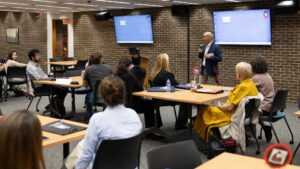
As departments submitted their 2025 annual assessment reports to Accreditation, Assessment and Evaluation (AAE), we asked them to respond to questions about their faculty’s involvement in assessment activities and the assessment practices in their academic units. These practices help shape how programs talk about student learning, engage with evidence and make decisions that improve the student experience.
We received over 100 responses. This information helps us understand how well departments are moving toward a continuous improvement model, and where additional guidance or support may be helpful.
Faculty Involvement: A Positive Trend
One encouraging finding is that a strong majority of respondents report that assessment responsibilities are shared within their programs, particularly in areas like developing measures, collecting data and reviewing findings. Most responses to involvement questions were in the “shared to some extent” or “shared to a great extent” categories.
However, fewer faculty reported shared responsibility for summarizing and reporting data. This makes sense, as reporting is often handled by a single coordinator or lead. Even so, the overall trend is that faculty engagement in assessment activities is strong and improving.
Clarity and Understanding: Mostly Strong, With Room to Grow
The climate data show that:
- Over 90% of respondents agree or somewhat agree that the purpose of assessment is clearly understood in their department.
- Roughly three quarters agree or somewhat agree that assessment for accreditation purposes is prioritized above other assessment efforts, though this item may have been interpreted differently than intended.
These results suggest that while faculty broadly understand the purpose of assessment, the framing of assessment work may still feel more compliance-oriented for some.
Comfort With Assessment: A Mixed Picture
When asked whether faculty feel intimidated by assessment, responses were split across the scale, resulting in just over half of respondents expressing comfort with assessment activities overall.
This tells us two things:
- Many faculty enter assessment conversations with confidence.
- A substantial portion remains unsure. This signals opportunities to clarify processes, demystify requirements and reinforce that assessment is not a high stakes evaluation of individuals but a collective tool for improvement.
Belief in Assessment’s Value
About two-thirds of faculty agree or somewhat agree that assessment genuinely supports student learning in their program. While this is encouraging, the remaining third of responses fall into neutral or disagreeing categories, suggesting:
- Some faculty may not see clear connections between assessment results and meaningful program decisions.
- Others may engage in course-level assessment already but may not see how program-level assessment builds upon or aligns with this work.
Departments might consider discussing results during standing meetings (e.g., curriculum committees, program area meetings) to help faculty see the impact of their contributions.
Assessment as Part of Continuous Improvement
Nearly 90% of respondents agree that assessment is expected as part of their department’s continuous improvement practices, and a similar percentage report that department leadership regularly shares assessment data with faculty. This is an important cultural indicator:
- Sharing data openly and integrating assessment into routine decision making is a hallmark of a strong assessment climate.
Key Opportunities for Strengthening Assessment Practices
Based on themes raised across programs, here are some opportunities to support faculty and strengthen assessment practices:
- Clarify the purpose and value of assessment beyond compliance.
- Reinforce how assessment insights lead to curriculum refinement, student support improvements or instructional adjustments.
- Reinforce that assessment is intended to inform program decisions, not evaluate individual faculty performance.
- Share examples of how assessment results have led to curricular revisions, course sequencing changes or improved student support.
- Distinguish between accreditation requirements and ongoing program improvement to reduce compliance‑focused perceptions.
- Use department meetings as consistent venues for discussing results and identifying improvements.
- Build in short, focused discussions of results during existing meetings (e.g., curriculum or assessment committee meetings).
- Center conversations on what the results suggest, rather than on the mechanics of data collection.
- Document discussions informally so faculty can see how their input contributes to program‑level decisions.
- Streamline data collection and reporting processes.
- Identify where data already exist (e.g., course assignments, capstone projects) and reuse them for program‑level assessment.
- Leverage O365 tools such as Excel, SharePoint or Teams to reduce duplication and improve access to results.
- Clarify which assessment tasks require broad faculty involvement, and which are handled by coordinators or leads.
- Emphasize that many faculty already engage in assessment.
- Acknowledge that grading, feedback and course assessment already provide valuable evidence of student learning.
- Clarify how program‑level assessment connects existing course‑level work across the curriculum.
- Highlight that assessment formalizes and aligns work faculty are already doing, rather than adding entirely new tasks.
- Ensure faculty have the information and resources they need to feel confident contributing to improvement efforts.
- Provide clear guidance on assessment expectations, timelines and roles within the department.
- Offer targeted support (templates, examples, brief consultations) to address common questions or pain points.
- Encourage departments to contact their AAE Assessment Partner for help facilitating conversations or refining practices.
Many departments are already doing much of this work successfully; small adjustments in communication, structure, and support can further strengthen assessment as a shared, meaningful practice.
If you’d like a brief consultation with your AAE partner or want help facilitating a conversation with faculty, we’re happy to collaborate. Your AAE Assessment Partner is here to support conversations, help align plans with meaningful learning goals and identify strategies to make assessment more manageable and impactful.
- Amy Buhrow, assistant vice provost for Assessment and Accreditation, supports the College of Education, College of Health and Human Sciences and College of Law.
- Carrie Zack, associate director, Accreditation, Assessment and Evaluation, supports the College of Liberal Arts and Sciences.
- Tawanda Paul, senior research associate, supports the College of Business, College of Engineering and College of Visual and Performing Arts.
- Jason Reed, institutional research data coordinator, supports Cocurricular Programs and General Education.
-

- Amy Buhrow
-

- Carrie Zack
-
- Tawanda Paul
-

- Jason Reed
