
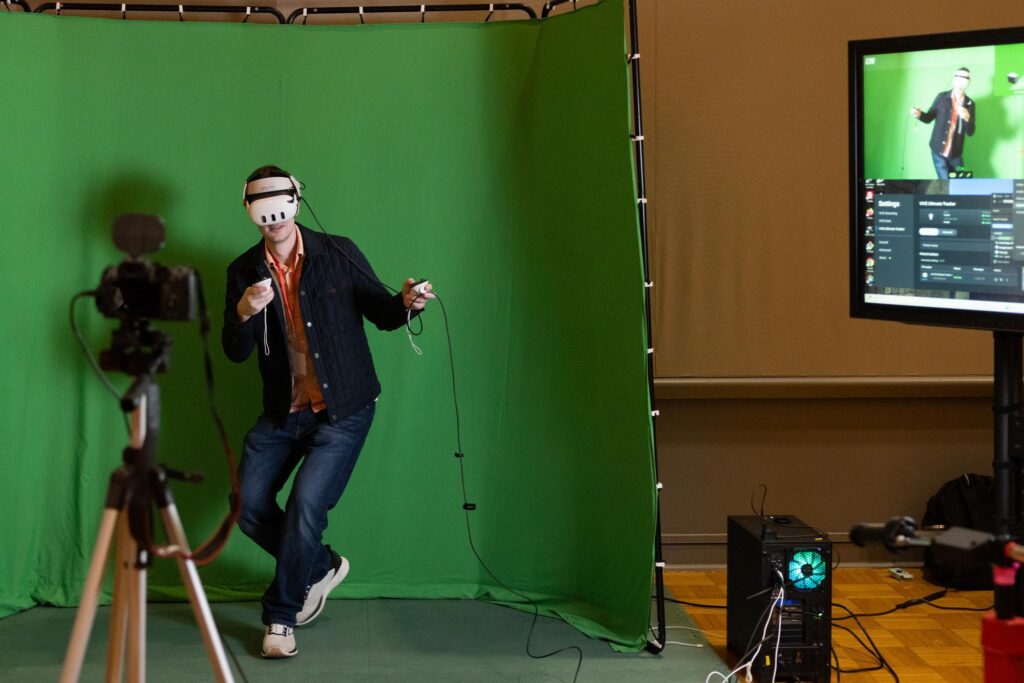
Artificial intelligence (AI) is transforming disciplines across college campuses, and an AI Roundtable at NIU’s 2026 Conference on Undergraduate Research and Engagement (CURE) showcased just how wide that impact can be.
The roundtable brought together five students from distinct academic programs to share their research and reflect on AI’s opportunities and challenges. The conversation highlighted technical innovation, ethical questions, human-centered design and the growing need for interdisciplinary collaboration.
Representing computer science, industrial and systems engineering, education, business and mathematical sciences, the panelists demonstrated how AI is shaping inquiry across fields.
Computer science major Shaivil Patel presented work on a video-based method for detecting gait cycles—an early step toward identifying autism spectrum disorder through observable walking patterns. By combining pose data with an iterative algorithm that identifies heel-strike patterns, Patel’s team is building toward a smartphone-based screening tool. The approach, designed to work with real-world video data, could make early autism screening more accessible and objective.
Angelica Sanyal, an industrial and systems engineering major, is helping validate iGAIT, a mobile-accessible web application that uses AI and computer vision to analyze gait patterns. Sanyal emphasized the public health potential of earlier, more equitable screening, especially given that many children are not diagnosed until later stages. Together, the two projects illustrated how AI research often spans multiple domains—pairing algorithm design with usability, accessibility and real-world impact.
Rachel Stowers, a middle level teaching and learning major, examined how educators perceive generative AI in classrooms. Drawing on survey responses from 330 Illinois educators along with supplemental interviews, her research revealed both curiosity and concern. While younger educators reported strong familiarity with AI tools, many expressed discomfort with ethical implications. Respondents were generally more wary of students’ use of AI than their own, underscoring the need for clearer guidance and classroom norms.
The human dimensions of AI also surfaced in Anthony Baptiste’s research in operations management and information systems. Baptiste explored whether large language models can effectively simulate interview responses in qualitative research. His findings suggest that while AI can replicate structured reasoning and general knowledge, it often falls short in conveying emotional nuance and lived experience—limitations that are critical in fields that rely on authentic human perspectives.
Rounding out the panel, Hannah Freitag, a mathematical sciences major, investigated how machine learning models recognize handwritten characters. By comparing neural networks trained on simplified data representations with more complex convolutional neural networks, Freitag demonstrated how design decisions affect performance, efficiency and model complexity. Her work highlighted the foundational role of mathematics in advancing AI capabilities.
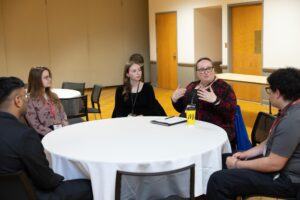
Stephanie Richter, director of Teaching Excellence and Support in NIU’s Center for Innovative Teaching and Learning facilitated the conversation and guided students to reflect on connections across their projects—despite their varied disciplines. Themes of access, accuracy, ethics and human context emerged as part of the discussion.
“Each project demonstrated how AI stretches the boundaries between disciplines,” Richter said. “The students’ research pulled them out of their comfort zones and brought valuable insight about areas they had never studied.”
For example, Patel and Sanyal both worked with iGAIT, which includes a broad range of disciplines, including computer science, industrial engineering, kinesiology and more. Sanyal noted that working with students from other disciplines strengthened their work.
The students also shared valuable lessons about AI. Patel positioned AI as a tool rather than a replacement for human judgement. Baptiste’s research has made him more cautious and critical of AI output. Freitag noted that her research was an effective demonstration that AI is limited by its prior training; it serves as a useful reminder that AI does not “know” anything unless it is explicitly trained on it.
The students’ research experience has shaped their next steps. Patel shared that his work has inspired him to pursue graduate study in bioinformatics, where he hopes to continue applying computational methods to human health challenges. Sanyal highlighted the coding and problem-solving skills she developed, noting their applicability across engineering and beyond.
Stowers described gaining a deeper understanding of teaching practices through engagement with experienced educators, strengthening her preparation for the classroom. Baptiste indicated his project left him more cautious about relying on AI outputs and better equipped to critically evaluate the technology’s limitations. Freitag pointed to the analytical and computational skills she built as a foundation for future study in computer science and machine learning applications.
The roundtable exemplified CURE’s mission to highlight undergraduate research that is rigorous and relevant. It also reflected NIU’s growing engagement with AI as a cross-cutting area of inquiry—one that invites students to explore not only what the technology can do, but how it should be used.
